
In the early stages of a B2B company, SaaS is a godsend. For a few hundred € a month, you can rent world-class infrastructure for CRM, project management, and billing. But as your operations scale and your processes mature, that same SaaS stack often transforms from an accelerator into a silent tax on your growth.
SaaS (Software as a Service) - a business model, where software is effectively being rented to clients. You pay for the right to use the software, but it is not your.
Most founders view software as an operational expense (OpEx). However, there is a specific inflection point where continuing to pay for a fragmented suite of off-the-shelf tools becomes more expensive-and riskier-than building a custom internal asset.
This guide outlines the strategic framework for identifying that tipping point and transitioning to custom software that functions as a high-performance company asset.
The SaaS graveyard and the fragmentation of truth
The modern enterprise typically operates on a "Frankenstein" stack. You use HubSpot for leads, Notion for documentation, Jira for tasks, and perhaps a specialized tool for your core service delivery. On the surface, this looks efficient. Under the hood, it creates a "fragmentation of truth."
When your business logic is scattered across five different platforms, none of them truly understand your business. You are forced to bend your unique workflows to fit the rigid data models of a vendor. If your process for onboarding a client requires a specific sequence that doesn't fit the CRM’s "standard" pipeline, you end up with manual workarounds, spreadsheets to bridge the gaps, and a significant amount of "human middleware."
Your team spends 20% of their day moving data from one tool to another. This is the first symptom of the "SaaS tax."
Identifying the hidden "SaaS tax"
The SaaS tax is not just the line item on your credit card statement. It is the cumulative cost of inefficiency, data leakage, and lack of agency.
-
The integration gap
Standard integrations (like those found on Zapier) are often brittle. They handle "happy path" data transfers but fail when complexity increases. When an integration breaks, your operations halt. The time your senior staff spends debugging why a lead didn't sync is high-value time lost to low-value maintenance.
-
Feature bloat and the "lowest common denominator"
Large SaaS vendors build for the mass market. You are likely paying for a feature set where you only use 15%. Simultaneously, the 5% of functionality that would actually give you a competitive advantage is missing from their roadmap. You are subsidizing features for other companies while your own specific needs remain unaddressed.
-
The scaling penalty
Most SaaS pricing models are seat-based. As you hire, your software costs grow linearly, but the value you derive from that software often plateaus. In a custom-built environment, the marginal cost of adding a new user is near zero. With a 20,000€ annual SaaS spend, you aren't just losing money; you are renting your own operational efficiency.
-
Data sovereignty and risk
When your core operational data lives in a third-party database, you are at the mercy of their uptime, their security protocols, and their price hikes. You don't own the "pipes" of your business; you are merely a tenant. If the vendor pivots or sunsets a feature you rely on, your business faces significant structural risk.
The solution - building high-performance custom assets
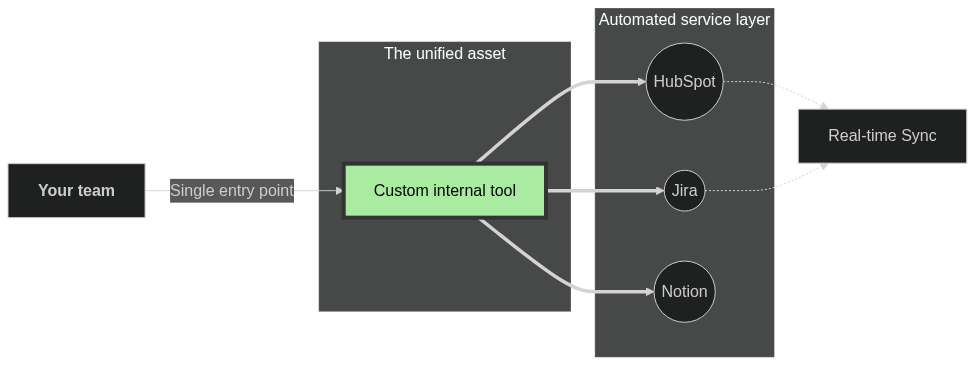
At codus, we view software not as a utility bill, but as a capital asset. A custom internal tool is a one-time investment that creates a permanent increase in your company’s valuation and operational capacity.
Turning OpEx into a long-term company asset
When you build a custom tool, you move the spend from your profit and loss (P&L) statement to your balance sheet. You are creating intellectual property (IP).
For most companies, a custom-built operations dashboard or a proprietary workflow engine is a "moat." It allows you to execute faster, with fewer errors, and at a lower marginal cost than competitors who are stuck using the same generic tools as everyone else. When it comes time for an exit or a funding round, owning your core infrastructure is a significant value driver.
How to calculate productivity gains
To justify a build, we look at the "unified workflow" metric.
Calculate the time saved by eliminating manual data entry and context switching. If a custom tool saves a team of 10 people just 3 hours each per week, that is 1,560 hours per year. At an average internal cost of 50€/hour, that is 78,000€ in reclaimed productivity annually.
Suddenly, a 20 000€ – 30 000€ investment in a custom build doesn't look like a cost - it looks like a high-yield investment with a four-month payback period.
The strategic framework: Build vs. buy
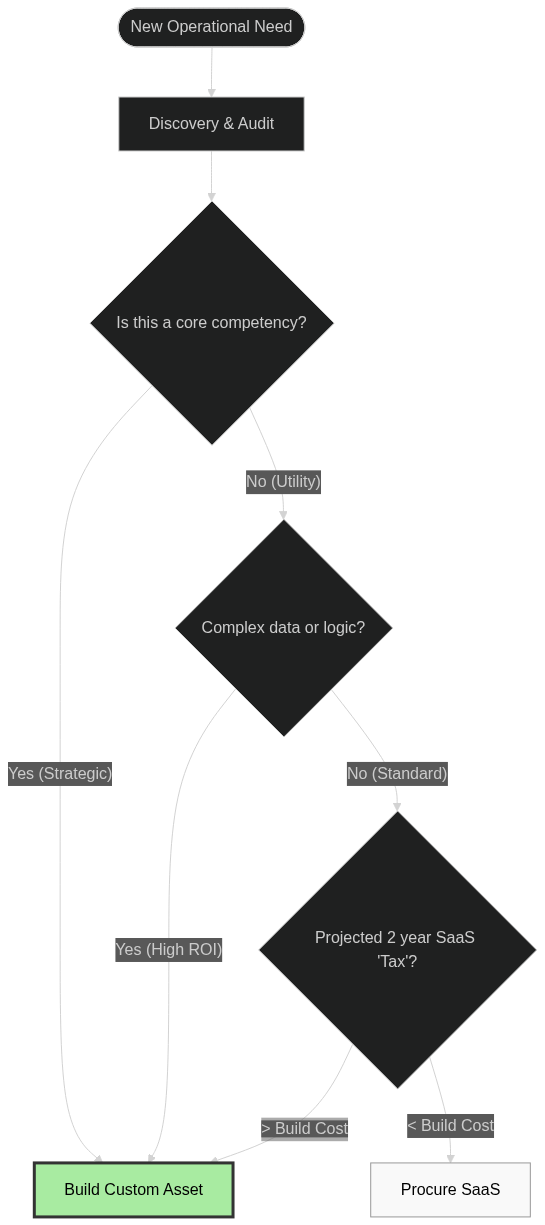
How do you decide when to pull the trigger? We use a three-pillar framework:
-
The specificity of the process
Does your workflow provide a competitive advantage? If your process is "standard" (e.g., payroll or basic email), buy. If your process is "proprietary" (e.g., a unique way of managing logistics, a specific data analysis method, or a high-touch client onboarding), build. Never outsource your core competency to a generic tool.
-
The data complexity
If you need to aggregate data from multiple sources to make real-time decisions, a custom "single source of truth" is mandatory. SaaS tools are designed to keep data in, not to share it. A custom build allows you to design a schema that matches your business reality perfectly.
-
The "seat count" threshold
If your projected SaaS spend over the next 24 months exceeds the cost of a custom build (typically in the 15k – 25k range for a focused MVP), the financial argument for building is settled. You are better off owning the asset than continuing to pay rent.
The codus approach: Risk mitigation and technical excellence
The biggest fear for founders regarding custom software is the "never-ending project." We mitigate this through a highly focused, highly skilled team approach. We don't build "everything"; we build the "right thing."
Architectural longevity
We use modern, scalable stacks (modern full-stack frameworks and robust relational databases) that are easy to maintain. We build with an "API-first" mentality, ensuring that your custom tool can still talk to necessary third-party services (like Stripe for payments or and S3 provider for storage) without being beholden to them.
Phased deployment
We don't believe in "big bang" releases. We identify the most painful friction point in your current workflow and build a focused solution for that first. This ensures immediate ROI and allows the software to evolve based on actual usage data rather than assumptions.
Security and performance
By reducing the number of third-party plugins and "no-code" bridges, we significantly reduce your attack surface. Custom tools are leaner, faster, and more secure because they don't carry the "bloat" of a platform trying to be everything to everyone.
Final thoughts: Stop renting your efficiency
The goal of a founder is to build a scalable, repeatable machine. If the core of that machine is made of rented parts that don't quite fit together, the machine will eventually shake itself apart under the pressure of scale.
Custom internal tools are for companies that have outgrown the "startup" phase and are ready to optimize for serious growth. By identifying the SaaS tax early and converting those operational expenses into custom assets, you secure your data, empower your team, and build a more valuable company.
If your team is currently fighting against your tools instead of being empowered by them, it’s time to stop paying for subscriptions and start building your own infrastructure.