

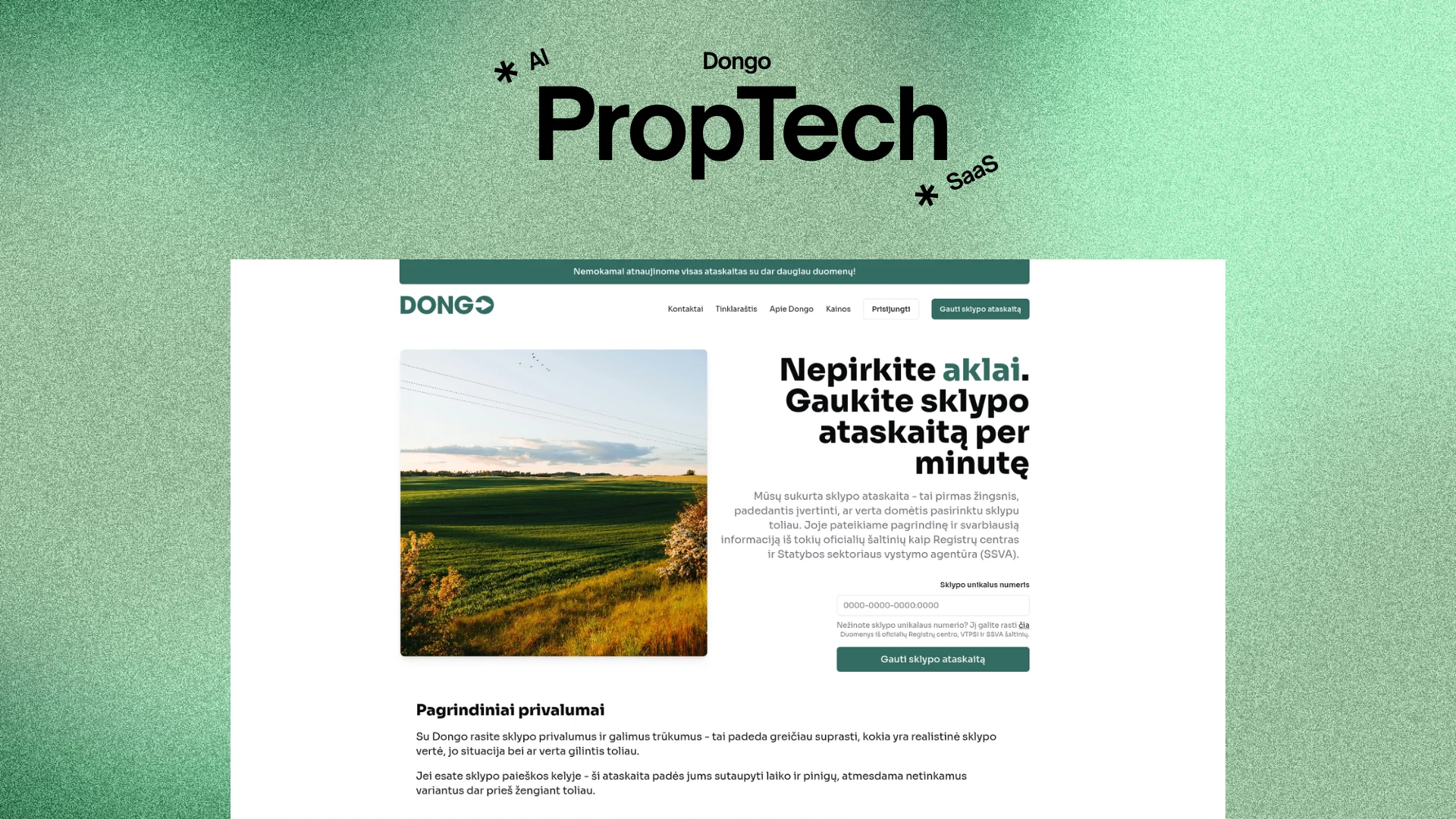
The context
The Lithuanian real estate market relies on data from the Lithuanian Centre of Registers (Registrų centras), which is notoriously difficult to access and interpret in its raw form. For Dongo, the objective was to democratize this data by building a consumer-facing SaaS that provides instant clarity on any land plot in the country.
The bottleneck: Data fragmentation & interpretation
The project faced two primary engineering hurdles that prevented a standard web approach from succeeding:
- The Spatial Performance Gap: Standard relational databases struggle with high-load queries involving geographical coordinates and land boundaries. Without optimization, retrieving plot data was too slow for a modern user experience.
- The "Legal Jargon" Barrier: Raw registry entries are filled with technical and legal terminology. For a SaaS to provide value, it needed to do more than just display data — it had to explain it.
The technical mechanism: Spatial optimization & AI layering
1. High-performance spatial indexing
We architected the backend using PostgreSQL and PostGIS, implementing GIST (Generalized Search Tree) indexing for all spatial data.
- The Result: This allows the system to perform complex "point-in-polygon" calculations and distance lookups across thousands of records in milliseconds, ensuring the app remains responsive even under heavy concurrent loads.
2. LLM-driven insights engine
To solve the interpretation problem, we integrated a custom AI reasoning layer. This engine ingests raw registry entries and uses Large Language Models to generate human-readable summaries.
- The Result: Instead of viewing a cryptic PDF or government site, users receive a structured report detailing potential risks, land use restrictions, and development opportunities in plain language, creating a significant competitive advantage in the PropTech market.
3. Optimized data pipeline
We built a robust ingestion pipeline that normalizes fragmented registry data into a unified, high-availability database. By decoupling the data ingestion from the user-facing API, we ensured that the application maintains 100% uptime during heavy data synchronization tasks.
The impact: Delivering market transparency
By focusing on engineering rigor over simple data display, Dongo has been positioned as a leader in Lithuanian land data analysis.
| Metric | Business Outcome |
|---|---|
| Search Latency | Sub-500ms response times via PostGIS optimization |
| Data Interpretation | Automated AI summaries replacing manual legal review |
| SaaS Scalability | Cloud-native architecture ready for thousands of concurrent users |
The bottom line
Dongo proves that the value of a SaaS isn't in the data itself, but in the speed and clarity with which that data is delivered. We moved the friction from the end-user to the architecture, creating a high-barrier-to-entry product that turns raw data into actionable intelligence.
We didn't just build a map; we built an interpretation engine. By solving the spatial performance problem and layering AI insights, we’ve turned the Lithuanian land registry into a transparent, user-centric asset.