

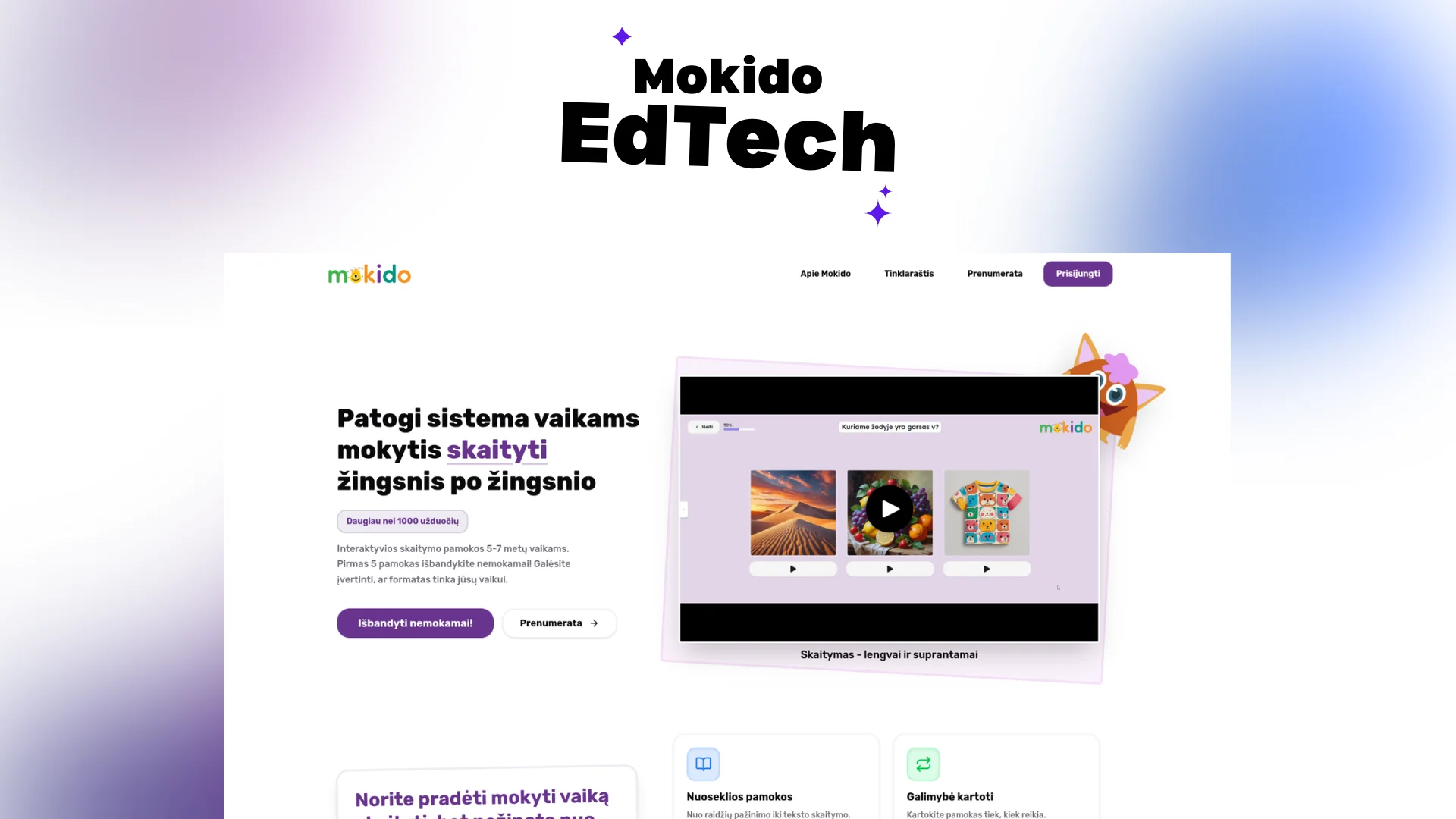
The context
In the competitive EdTech landscape, the primary cause of platform failure isn't a lack of content—it’s the cost of scaling that content and the churn rate caused by linear learning paths. For Mokido, a lithuanian literacy platform, the goal was to build a system that could sustain high engagement without requiring a massive internal dev team to hard-code every new lesson.
The bottleneck: Manual scaling & static logic
When we audited the initial requirements, we identified two critical technical risks that would have choked the company's growth:
- The content deadlock: Relying on developers to deploy new learning tasks is a bottleneck. To scale, mokido needed a system where educators—not coders—could build the curriculum.
- The progression gap: Generic "pass/fail" logic leads to frustration. If a child doesn't grasp a specific phonetic concept, pushing them forward creates a "knowledge debt" that leads to churn.
The technical mechanism: Decoupling content from code
1. Schema-driven task architecture
Instead of building static levels, we developed a JSON-schema-based engine. This allows administrators to create complex, interactive tasks (syllable matching, sentence construction, audio-visual pairing) via a custom-built dashboard.
- The result: The core engine remains untouched while the curriculum expands infinitely. This architectural choice reduced manual it intervention by 50%.
2. Algorithmic mastery loops
We replaced linear progression with an adaptive remediation loop. The system tracks granular data points on user errors.
- If a specific phonetic pattern is missed, the algorithm intelligently reshuffles the queue to re-introduce the "failed" concept in a new context. This ensures 100% mastery before the user moves to a higher-difficulty tier, significantly increasing long-term retention.
3. Cognitive load management
Retention in children's apps is a balance of "flow state" and "fatigue."
- Tactical micro-breaks: We integrated automated 10-minute "reward sessions" between intensive literacy blocks. This manages the child's cognitive load, ensuring they remain in a high-receptive state for longer periods, resulting in the 80% engagement increase noted in our metrics.
The impact: Operational & user metrics
By focusing on the "engine" rather than just the "interface," we delivered a platform that outperforms industry standards in both cost and performance.
| Metric | Business outcome |
|---|---|
| User engagement | 80% increase via adaptive difficulty and reward loops |
| Admin efficiency | 50% reduction in manual overhead for curriculum updates |
| Maintenance cost | 40% lower IT costs through schema-driven scalability |
The bottom line
The success of Mokido proves that in EdTech, the "playful" element is only as good as the "logic" supporting it. we built a scalable, sustainable business asset that allows the mokido team to focus on educational excellence while the software handles the complexity of scaling.
We moved the complexity from the code to the configuration. Mokido is no longer just an app; it's a content-independent engine that solves the scaling problem inherent in digital education.